
Keep an incident decision log that people can use
Capture the reasoning behind response actions so technical and business teams can stay coordinated.
Read article : Keep an incident decision log that people can use

RANSOM SECURE / FIRST-HOUR RANSOMWARE CHECKLIST
A practical guide to initial observations, trusted communication and coordinated decisions after a suspected ransomware incident.

Use your organization’s incident plan and a trusted contact route. A website checklist cannot assess the event or authorize containment. If essential services or people may be at risk, involve the responsible operational and emergency contacts promptly.
THE FIRST PRIORITY IS CLARITY
Ransomware can affect access to files, applications and business services. An unusual message, unexpected encryption or a security alert may be the first sign, but the visible symptom does not establish the full scope of an incident.
Avoid a rush to make unrelated changes. Establish who is coordinating, which communication route is safe and which observations need preserving. Response work may run in parallel; the sequence below is a way to organize decisions, not a promise that an incident can be resolved in sixty minutes.
A PRACTICAL RESPONSE SEQUENCE
01
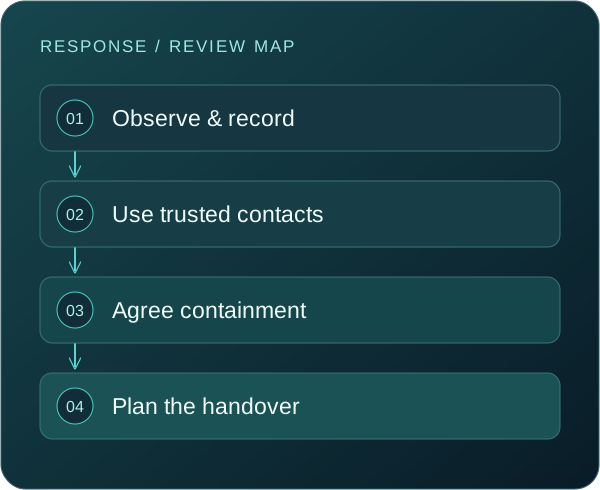
Contact the designated responder or IT lead using contact details already known to the organization. If normal email may be affected, use an agreed alternative. Name a coordinator and a person who records decisions so that technical staff are not receiving conflicting instructions.
02
Record which service is affected, when the issue was noticed and what people can no longer do. Capture exact alert wording and useful timestamps where safe. Separate a direct observation from an assumption about the attacker, entry route or extent of compromise.
03
Isolation can help limit spread, but the appropriate action depends on the affected system and operational consequences. Follow the incident plan and responder guidance. Avoid blanket shutdown, wiping or rebuilding before the team has considered evidence and safety.
04
Identify who administers backups and recovery infrastructure. Responders should assess whether those systems or credentials may be affected. Preserve relevant logs and original messages through an agreed process; do not upload sensitive incident evidence into a general contact form.
05
Keep a concise record of decisions, responsible people, affected services and outstanding questions. Set a time for the next update. Coordinate business, legal, insurer and communications contacts where applicable rather than making unsupported public statements.
YOUR FIRST-HOUR REVIEW
Tick an item when it has been reviewed with the responsible person. An unchecked item is a prompt for follow-up, not a diagnosis. Selections stay in this page and disappear on refresh.
Use your approved incident system for the detailed record. This checklist is not a secure evidence repository and does not contact an incident response team.
THREE CONNECTED WORKSTREAMS
Business coordination establishes priorities and authority. Technical response investigates scope and containment. Recovery preparation identifies the people, dependencies and copies needed to restore agreed services when it is appropriate to do so.
These workstreams need a shared record. An executive should not receive an unexplained “all clear” while technical questions remain open, and a restoration team should not reconnect a system without the agreed validation and approval.
DECISIONS TO HANDLE CAREFULLY
A restart or rebuild may change evidence and may not remove the cause of compromise. Coordinate the action with the incident lead and the people responsible for the system. Record what was changed and why.
The newest copy is not automatically a safe recovery point. Recovery decisions should consider the compromise timeline, available evidence, system integrity and the dependencies needed for useful operation.
Use a controlled distribution list and a trusted channel. Share what each recipient needs for their role. Original evidence, credentials and sensitive customer information should follow an appropriate handling process.
Payment does not establish that systems are safe, data will be restored or stolen information will be removed. Decisions involving an extortion demand need specialist advice and appropriate organizational authority.
QUESTIONS THAT MATTER
Do not apply a blanket action without considering the environment. Follow the incident plan and authorized responder guidance. The appropriate containment action depends on the suspected spread, affected systems and operational or safety consequences.
Use your established incident contact route and involve the people responsible for your systems. External support can be coordinated alongside them. An enquiry does not by itself confirm availability or begin an emergency engagement.
A brief description of the affected service, when the issue was noticed and a safe callback route. Keep passwords, recovery keys, customer records and confidential evidence out of the general website form.
That decision requires an assessment of scope and dependencies. A service that appears unaffected may still share identities or infrastructure with an affected system. Ask the response lead to define permitted activity.
It prompts you to involve the appropriate advisers. Notification requirements depend on the incident, contracts, policies and applicable law. Obtain qualified advice rather than relying on a general checklist.
No. It structures the first conversation and review. Your organization needs defined roles, contact routes, technical procedures and rehearsed decisions appropriate to its own operations.
KEEP EXPLORING
Capture the reasoning behind response actions so technical and business teams can stay coordinated.
Read article : Keep an incident decision log that people can useA recent backup is a starting point. Check what it contains, what it depends on and whether it supports the service you need.
Read article : Before you restore: evaluate the recovery pointPlan a recovery rehearsal that checks data, dependencies and a useful workflow—not simply a successful backup console message.
Read article : A restore test should end with a business checkFurther reference: CISA #StopRansomware Guide. This resource is practical guidance, not a certification or a substitute for an assessment of your environment.
TURN INFORMATION INTO ACTION
Tell us what you want to protect, where the uncertainty is and who needs to be involved. We will discuss the scope and practical next steps with you.