Every account represents
a route into your business.
Identity security connects people, applications and permissions. It determines who can sign in, what they can reach and which actions they can perform. That boundary changes whenever somebody joins, changes role, receives temporary access or leaves.
An account can be legitimate while its permissions are excessive. A successful sign-in can still come from a compromised session. Review authentication, authorization and account lifecycle together instead of treating a strong password as the complete answer.
THREE DIFFERENT QUESTIONS
Who is it?
What may they do?
What actually happened?
Authentication checks an identity claim. Authorization determines the permitted resources and actions. Logging helps you understand activity and investigate exceptions. Each needs an owner and a clear relationship to the business task.
Use managed identities and appropriate multifactor authentication. Where available and suitable, phishing-resistant methods can reduce reliance on codes or approval prompts that attackers may manipulate. Account recovery must be protected as carefully as ordinary sign-in.
ACCESS SHOULD FOLLOW THE WORK
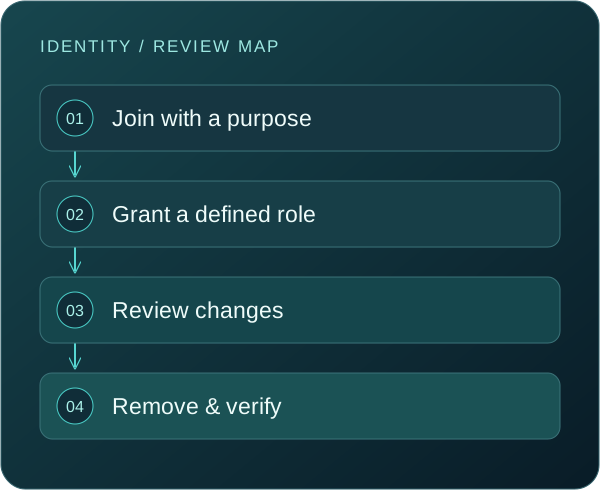
Join. Change. Leave.
Review the transitions.
01
Joining the organization or project
Identify the manager or service owner who approves access. Start with the role’s actual requirements and explain the approved sign-in and recovery process. Avoid granting broad permissions simply because they may be useful later.
02
Changing role or responsibility
Remove access that belonged to the old role as well as adding what the new role needs. Review privileged groups, shared mailboxes, project workspaces and connected applications. An active employee account can still retain inappropriate historical access.
03
Receiving temporary or external access
Define the task, permission boundary and end date. Use named identities where possible and record who owns the relationship. Supplier or guest access should not continue indefinitely because nobody was assigned to review it.
04
Leaving or closing an engagement
Coordinate account disablement, sessions, tokens, devices and ownership transfer. Preserve required business records through an approved process. Offboarding is more than deleting a visible user from one application.
DIFFERENT IDENTITIES, DIFFERENT CONTROLS
Review the access
that can change the most.
Everyday user
Give staff the access required for ordinary work. Keep elevated administration separate, make reporting easy and review unused accounts and shared access routes.
Privileged administrator
Use narrowly scoped administration, strong authentication and controlled approval. Review emergency access and logs. A powerful account deserves a deliberate lifecycle and regular evidence-based review.
Guest or supplier
Name a business sponsor, define the resource and time period, and confirm how access ends. Review sharing links and workspace membership alongside the user account.
Application or service account
Identify the owner, purpose, permission scope and credential lifecycle. Non-human identities can retain access after the original integration changes or the person who created it leaves.
WHEN A ROUTINE REQUEST NEEDS A CHECK
Make the exception
process dependable.
“I have a new phone. Reset my authentication.”
Use the established identity-verification and recovery process. Urgency, a familiar voice or knowledge of a colleague does not independently establish authority. Record the exception and escalate when the request does not fit the expected pattern.
“The supplier needs full administrator access.”
Ask what task requires the access and whether a narrower permission or supervised session would work. Agree the approver, duration, monitoring and removal process before enabling the access.
“This app wants to read all our files.”
Review the publisher, purpose and requested permissions. Consent is an access decision, not merely an installation step. Determine what the application can retrieve and how that permission can be revoked.
“The password was changed, so the account is safe.”
A password change may not remove every session, token, delegated permission or persistence mechanism. Coordinate investigation and containment with the responsible team and platform guidance.
A FOCUSED ACCESS REVIEW
Start with one
critical application.
Choose a system that supports important work and ask its owner to review the actual access list. Include people, groups, guests, integrations and emergency accounts. Look for a current business reason for each route.
Record changes and exceptions through the approved process. Removing access without understanding a dependency can disrupt legitimate work; leaving unexplained access untouched can preserve unnecessary exposure.
The application and access decision owner are named.
Users and privileged roles match current responsibilities.
Guest access has a sponsor and review date.
Service accounts and integrations have an owner and purpose.
Authentication and recovery routes are appropriate to the risk.
Sessions, tokens and delegated permissions are included in response procedures.
Exceptions and removal actions have owners and follow-up dates.
Make the evidence repeatable.
Keep a dated record of the scope, approver, access list and decisions. Review again after role changes, new integrations or a suspected compromise. The objective is an understandable permission boundary that can be maintained as the business changes.
It is an important control, but permissions, account recovery, sessions, application consent and user behavior also matter. Review the complete access route and prioritize stronger authentication for sensitive or privileged access.
What is least privilege?
It means granting the permissions required for an authorized task, with an appropriate scope and duration. The review should consider what a person or application needs now, not every capability they might use later.
Why separate administrator access?
Administrative permissions can change systems and access boundaries. Separating routine work from elevated administration helps make that authority more deliberate and easier to control and review.
Do service accounts need review?
Yes. They may have broad or long-lived permissions and can be overlooked during employee offboarding. Record an owner, purpose, credential process and review date for each integration or service identity.
What should happen when a project ends?
Review guest memberships, shared links, application permissions and ownership of records. End unnecessary access while preserving information the business must retain. Record exceptions and their review dates.
Can we use this guide with our existing provider?
Yes. Ask the provider to supply technical evidence while the business owner confirms the purpose and appropriateness of access. Agree who performs changes and who validates the result.